
The curve learning curve is an important learning terminology in relation to kids learning pattern, and any other individuals.
This term simply refers to the time it takes an individual to develop knowledge or a new skill.
When a child is introduced to new information or a new skill, it may take a lot of time, or learning sessions to acquire that knowledge or skill.
You may notice a sudden change in the educational performance of your kids.
Assignments that used to be manageable and simple, but now become difficult. Confidence declines, and motivation weakens.
The change is often subtle at first, then increasingly noticeable.
Therefore, Psychologists refer to this acquisition procedure as the learning curve. Encyclopedia.
Traditional thinking presents learning as a steady upward progression:
Instruction → Practice → Improvement → Mastery
The Curved Learning Curve: A More Accurate Model of Learning
In reality, the model described above, does not reflect how the human brain actually processes new information—especially in children.
A more accurate model looks like this:
Exposure → Confusion → Performance Dip → Cognitive Adjustment → Breakthrough
That is the curved learning curve parttern a non-linear process where temporary setbacks are not only expected but necessary.
it’s our duty, be it parents, teachers, instructors, educators, to understand that there is a period of time a child who was once progressing steadily, may begins to struggle.
If that ever happens with your kids, you should not panic, because it’s not something new or strange, but a new pattern of the curve learning curve.
As a parent or educator, this may be deeply concerning.
You start asking questions:
- Did I miss something?
- Is my child becoming lazy?
- Is there a deeper problem?
- But here’s the truth that many people don’t talk about:
These persistent boring questions are valid. However, in many cases, the explanation is not failure—it is development.
To understand why kids suddenly struggle in school, it is essential to recognize a fundamental truth:
Learning is not linear.
Meaning that children do not progress in an expected straight predictable line, but rather develop in a pattern that includes periods of difficulty, adjustment, and eventual growth.
This pattern is best understood through what is known as the curved learning curve.
Improvement is not linear; learners often struggle before mastering a skill.
eLearning Industry.
This slowdown may feel like a sudden struggle, even though it is a normal part of the learning procedure.
Learning happens quickly at first, then slows as experience increases. Encyclopedia.com.
During the “dip” phase, children may:
- Perform below their previous level
- Struggle with concepts they once understood
- Show signs of frustration or disengagement
These changes can be mistakenly misinterpreted as signs of regression.
But, in reality, they often delinate that the child is transitioning to a deeper level of understanding.
Read About: Best Morning Routine for a 6- Year Old Before School .
Why Kids Suddenly Struggle in School
Clear understanding the underlying causes of this shift of non-linear learning behavior in children, helps prevent misjudgment and ineffective responses.
Below are some of the most important information to consider:
1. Transitioning to Higher Cognitive Demands
As children progress advancely so also learning moves from basic recall to complex thinking.
At this point, tasks begin to require:
- Analysis
- Interpretation
- Problem-solving
This transition can temporarily overwhelm the child’s current abilities.
2. Breakdown of Previous Learning Strategies
This is often described as a clear parttern of early success.
Early success is often built on memorization or repetition.
However, these methods become insufficient as academic demands increase.
So, when old strategies stop working, performance may decline until new methods are developed.
3. Cognitive Reorganization
This explains the reality behind cognitive development.
During cognitive development and restructuring, the brain continuously restructures new information to accommodate new knowledge.
This process—while essential—can temporarily disrupt existing understanding.
It is not unlike restructuring a system, instability may occur before improvement becomes visible.
4. Increase in self awareness and pressure
It was clearly noticed, that as children grow, they often become more aware of expectations, comparisons, and outcomes.
This awareness can introduce:
- Fear of failure
- Performance anxiety
- Avoidance behaviors
- Confidence if succeed on something
- Ownership defense-showing that this thing is mine
These emotional factors can directly affect academic performance.
Recognizing the Signs of a Learning Dip
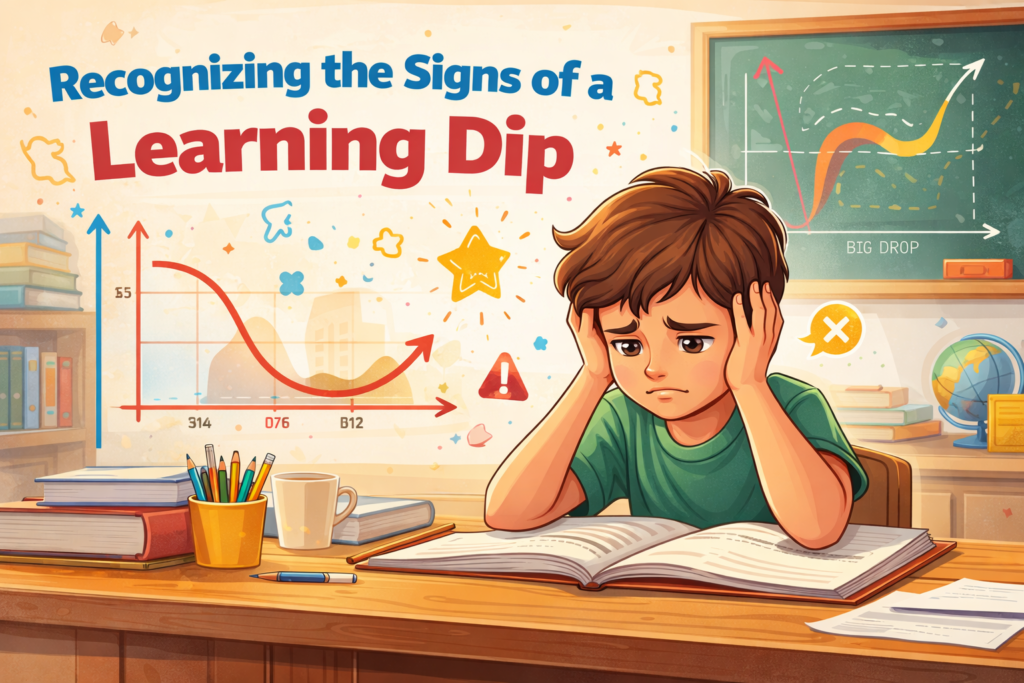
Learning dip, or you call it learning pit. This is a temporary drop in performance, confidence, and motivation. It usually happens after the initial excitement of learning new skills.
This situation often makes kids to feel that they’re going backwards.
It’s actually a critical stage, which need serious persistence, attention, and motivation, as mastery of learning these new skills lies beyond this level of frustration.
Identifying this period early help parents to provide the needful support their kids need.
Some Common indicators we may observe include:
- A noticeable drop in academic performance
- Increased frustration during study or homework
- Frequent expressions of confusion
- Avoidance of tasks previously handled with ease
- Declining confidence
It is important to interpret these signs correctly, that these are not necessarily indicators of inability, but rather signs of transition.
Also Read About: Why Kids Cling To Mothers more than fathers ( What Science Says)
Common Parental Responses That Worsen the Situation
Most parents when they noticed such situations with their kids, instead of taken the necessary measure to support the child to have a smooth transition, they end up worsening the situation.
This happens due to lack of useful information. Their intention is valid, but unintentionally intensify the situation.
Some of these unintentional reactions that worsen the situations, and that need to be observed carefully are:
- Increased Pressure— Demanding immediate improvement often leads to stress rather than progress.
- Comparison With Peers—Comparisons can damage self-esteem and create unnecessary competition.
- Mislabeling the Child — Describing a child as “lazy” or “careless” overlooks the underlying cognitive process.
- Overemphasis on Results —Focusing solely on grades ignores the importance of understanding and development.
Effective Strategies to Support Children in this situation
When you identified such a situation in your kids, make sure to never worsen the problem, instead, take the necessary important steps to help the child have a smooth transition.
Some of the best practical strategies that can work very well include:
- Focus on Process Over Performance
- Encourage understanding rather than speed or perfection.
- Normalize Difficulty
- Help children understand that struggle is a natural part of learning, not a sign of failure.
- Adapt Learning Methods
Different children respond to different approaches. Consider:
- Visual explanations
- Step-by-step breakdowns
- Real-world applications
- Encourage Active Engagement
- Allow children to ask questions, explore ideas, and participate actively in their learning process.
- Create a Supportive Environment — A calm, non-judgmental atmosphere encourages persistence and reduces anxiety.
Read About: Best Screen Time limit For Kids ( By Age Group)
When Is Additional Support Also Appropriate
A more informed approach can significantly improve outcomes. But In some cases, most parents rather seek for advise from the expert, or seek for help of a professional tutor.
This usually help children a lot, especially when they are handled by a well trained professional.
There are situations where external support becomes beneficial.
This does not indicate a deficiency. Rather, it reflects the need for a more tailored approach.
Professional support can include:
- Individual tutoring
- Academic coaching
- Learning assessments
- Such support can help identify gaps, adjust learning strategies, and rebuild confidence.
Most very busy parents in such situations, choose to explore the most flexible options through online platforms that connect them with qualified educators and specialists.
The key here is not simply to provide help, but to also ensure that the help aligns with the child’s learning style.
Some of these professionals can easily be hired from Fiverr under $10 to $25.
You can also choose to do it yourself, especially if you have time, understanding the correct situations, and following the right above mentioned strategies.
The Role of Emotional Development in Learning
It is also very crucial to mention at this juncture, that Academic performance can never be separated from emotional well-being.
When children struggle, they often experience:
- Frustration
- Self-doubt
- Anxiety
Addressing these emotions is very essential. Careful listening, giving positive reassurance, and validating children’s experience can significantly improve both thire emotional and academic outcomes.
Building Long-Term Resilience and Confidence
A solid sustainable success in children’s learning depends on resilience, and this can only be achieved when parents and educators are ready to help by:
- Recognizing effort rather than ability
- Encouraging persistence through challenges
- Allowing space for independent thinking
- Avoiding overcorrection
Confidence can only grow when children learn that difficulty can be overcome over time, and resilience is the most required quality.
Also Read On: 8 Best Classic Books For Kids (By Age & Reading Level)
Conclusion:
The Curve learning Curve: To understand the main reasons behind kids sudden struggle in school is to recognize that their struggle is not the problem, but part of the process and learning transition, from unknown to known, and from confusion, to mastery.
The curved learning curve provides a more realistic framework for interpreting these changes.
Rather than reacting with concern alone, and a well-informed support can transform this phase into an opportunity for growth.
Children are not defined by moments of difficulty, but they are shaped by how those moments are understood and how to use the best existing strategies to make a smooth transition possible.
Affiliate Disclaimer:
Some links in this article are affiliate links. Meaning that, we may earn affiliate commission if you make purchases through them at no extra cost to you.